The Journal · The ancient world
Gold: where jewellery began
Long before diamonds were cut, goldsmiths were shaping the metal into ornament. The craft is older than most of the stones we set in it.
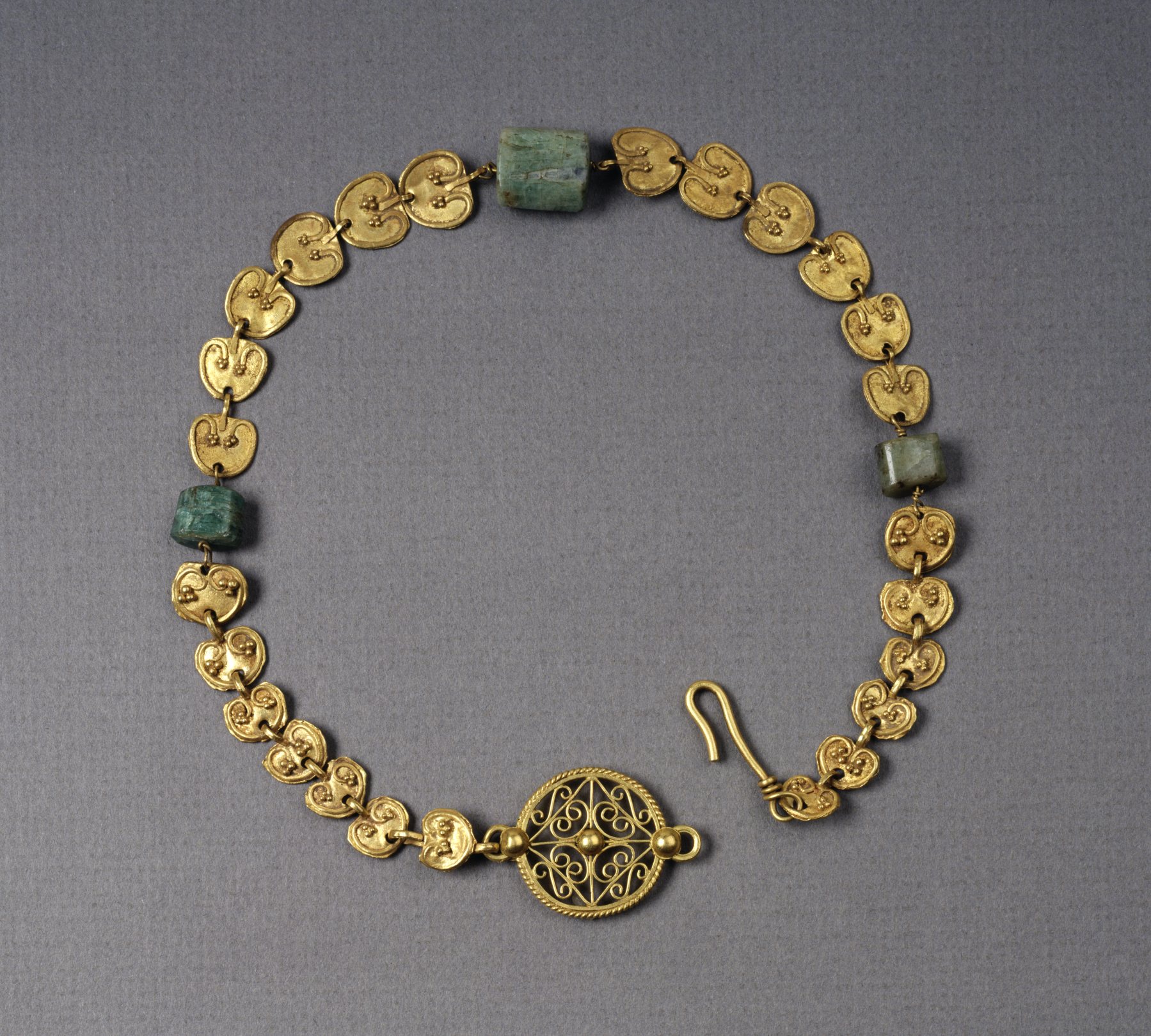
Gold was the first luxury. It lay in streams and riverbeds as bright nuggets, it never tarnished, and it could be worked with the simplest tools. Nothing else the early world knew behaved quite like it.
By the third millennium BC, goldsmiths in Egypt and Mesopotamia were making finely worked collars, diadems and amulets. Gold belonged to the sun and to the gods. The pharaohs were buried in it, and the treasure sealed in the tomb of the young king Tutankhamun, around 1323 BC, shows how far the craft had come.
Gold meets the gemstone
The Romans paired gold with pearls, emeralds, garnets and other coloured stones. Writers such as Pliny the Elder, in his Natural History, described the fashion for jewels at length, and often with disapproval. The necklace pictured here, with its gold plaques and green beads, is a Roman piece of this kind.
Why gold endures
Gold is soft enough to shape by hand and pure enough never to rust or fade. It is recognised and valued everywhere. It can also be melted and made again, which is why a ring made today uses the same metal, and much of the same patience, as the work of four thousand years ago.
That is why we refine our own. At Nadilini, every gram of gold is melted, purified and certified in our own refinery.